.jpg)

Other Gardens: Elena Salvini Pierallini
Updated: Apr 27
By Linda Falcone
Originally published in
RESTORATION CONVERSATIONS magazine

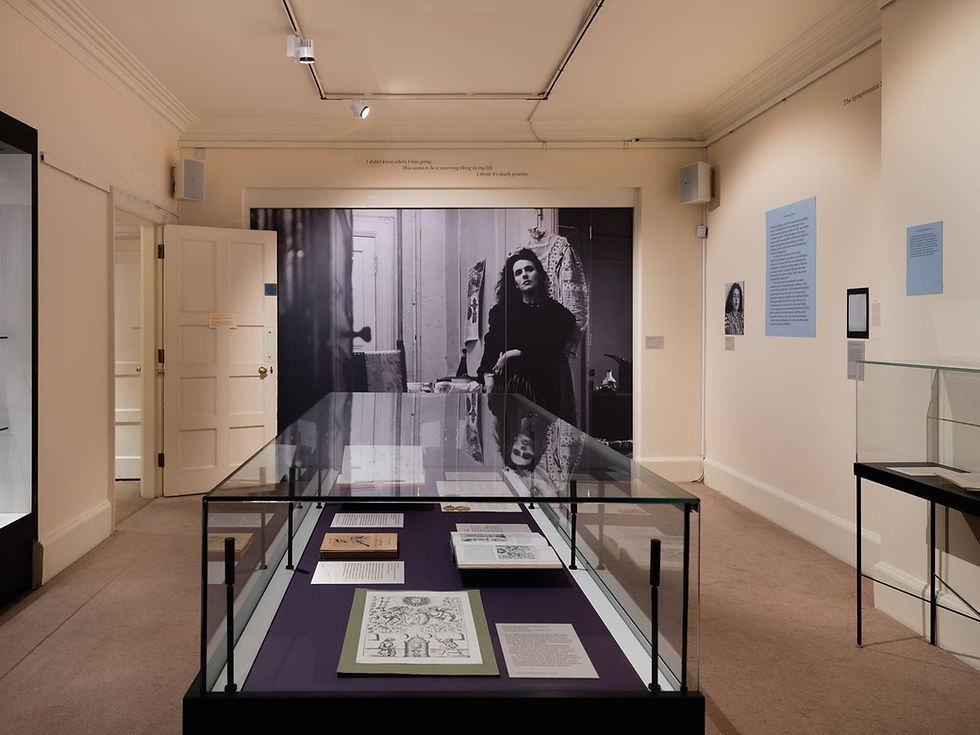
From ‘upright’ artbooks to time-lapse photographic series and larger installations, Florentine artist and photographer Elena Salvini Pierallini – known as ESP – produced a multi-faceted oeuvre, that was more than fifty years in the making. From June 15 to September 21 at Cultural Association Il Palmerino, the artist’s works will be on show in a retrospective exhibition entitled Other Gardens: Art by Elena Salvini Pierallini. Throughout the summer, ESP’s art will be at the centre of several city-wide events, hosted at historic villas, archives and cultural centres, known for their strong connection to the history of women from the sixteenth-century to the present day.
The artist’s daughters, architect Beatrice Pierallini and Sibilla Pierallini, an archaeologist turned Art History teacher, share insight on the sources of ESP’s inspiration, and reveal how they were inspired by a mother who, in their minds, ‘vivified everything she touched.’

Restoration Conversations: ESP began as a textile artist, working with embroidery. How did she get her start and what can you tell us about her early work?
Sibilla Pierallini: Our mother was introduced to embroidery by her mother, who worked as an embroiderer of tablecloths and tableware. ESP produced designs for her mother until the age of fifteen, after which she decided to transform embroidery into an independent art form, with no other purpose than to be viewed as art on the wall. ESP often depicted medieval symbols or portrayed scenes of human labour, because she found them representative of the European identity. Italy is a constellation of Roman cathedrals, and the same is true of France, Germany, and Spain – from the Path of Santiago to Jerusalem. These cathedrals host iconography associated with the passing of nature’s seasons and people at work throughout the year – themes that inspired our mother’s early work. In the 1960s and 1970s, ESP’s art featured many cultural symbols, from pastoral scenes to the signs of the zodiac, and technically, her works had two layers. On the top layer, made of organza, she embroidered, and on the silk layer underneath it, she’d paint.
Beatrice Pierallini: One interesting work of embroidery is her birds in flight, that become trapped in a spiderweb. ESP always loved to see birds soaring through the sky, as it gave her a sense of freedom. Yet, she was very conscious of the limits human beings have to grapple with – and women especially, for cultural and historical reasons. She identified with those birds trapped inside a web, and the work refers to the albatross in Baudelaire’s Fleurs du Mal. In that metaphor, when an artist flies high, he is majestic, but once he lands and finds himself in society, he is ungainly, clumsy. As an artist, ESP recognised the world’s constrictions. She always yearned for freedom of thought and action, but like many women artists in her time, she often found herself having to set aside her art to meet the demands of daily life.
RC: In the mid-1990s, ESP took a step back from embroidery and began working with other materials, like recycled or natural objects, including seashells, re-used plastic, and vintage fabrics passed on to her by her mother, used in combination with her photographs. Tell us more.
SP: She was always taking photographs; some were candid scenes, and others she assembled as still-life compositions. They were unique, and she put things together that were not usually associated with one another. She loved onions, for instance, and was struck by their colour, their layers – even when they were rotting. ESP had the ability to see things without prejudice and to find their beauty, when anyone else would have simply tossed over-ripe vegetables into the rubbish bin. Blackened bananas, wilting Swiss chard – anything could be immortalized as a celebration of colour. ESP considered cooking a waste of time; so while in the kitchen she produced artworks! That’s how she was; she always transformed her circumstances, and taught us to interpret our surroundings without preconceptions, by adopting a sense of curiosity. She taught us to see that discovery is the enjoyment of the unexpected.

RC: What can you tell us about ESP’s diaries, or Smemoranda?
BP: She started working with datebooks in the 1970s, and by the mid-1980s she produced them assiduously. She was committed to producing one diary page a day, as an exercise and a pastime that she found enjoyable. It was a moment she had to herself. We have 40 of these image diaries. At day’s end, she would say, ‘Do you want to see my little page?’ ESP was always keen on sharing her work with us, as children and in our adulthood as well.
RC: ESP’s series called Libri in Piedi, or ‘Books on their feet’, will be exhibited this summer in ‘pop-up’ events, at two monumental venues, Florence’s National State Archive (June 15 to June 22) and in the garden at Medici Villa La Quiete (July 2), as temporary extensions of the ‘Other Gardens’ show at Il Palmerino. Tell us more about the series.
BP: Our mother was very interested in book art, and she created books to flip through, and upright books as installations, called Libri in Piedi. As a person of great vitality, who vivified everything around her, ESP wanted to give books the dignity of standing upright like human beings; she wanted them to be able to ‘walk’. In her mind, every object has its own life experience and personalised memories. She worked with collage, using images from magazine clippings she collected in sets, with topics like ‘people reading’, ‘frogs’ and ‘hands’. She’d combine these clippings with her own photography or pieces of found objects she liked, and then, used thread, as a unifying force in her work. In her mind, art was a visual experience; she associated analogous forms and shapes to create a visual story, a narrative, that did not need to be explained or theorized.

RC: For more than a decade, ESP organised events among Florence’s local art community, inviting artists to complete art books she produced and handed out as part of her Borse Nere (Black Bags) initiatives. Le Murate, a former Florentine convent turned contemporary art centre, will host a similar event this summer in which today’s artists gather to complete several books ESP produced and left unfinished. How does Borse Nere work?
SP: During each of Borse Nere’s several editions, ESP invited twenty to thirty artists she held in high esteem, and sought to produce art in a collective or ‘choral’ way. It became a performance of sorts. Her incomplete art books were tucked inside the huge black bags she gifted to her peers, which was meant to symbolize the artists’ subconscious. Here is what ESP wrote about them: “These bags are containers of thoughts, images, memories and projects, anger, fear, nostalgia, colours and beauty”. Inside the bag, artists put whatever they liked – their tools perhaps, or some sources of inspiration. These events involved a lot of show-and-tell among the artists, and with the public at large. We are delighted for the opportunity to relaunch mother’s black-bag idea. Artists will receive their bags at Villa La Quiete in July, and then present their works at Le Murate, three months later, in September.
RC: ESP is an eclectic artist and photographer, whose work largely escapes classification. How would you describe your mother’s oeuvre in a nutshell?
SP: As an artist, ESP was interested in construction, never destruction. Her work was not an act of denouncement, or a criticism of society. She had an absolute respect for animals and the natural world, and they feature predominantly in her work no matter the medium. On some level, her oeuvre is Matisse-like, in that she focused on building an alternative reality made in the image and likeness of her own desires. Elena loved the writings of Voltaire and referenced his views in her art: since humans lack any kind of existential certainty – being at the mercy of the Gods – our only alternative is to cultivate our interests. She believed in reaching beyond frustration, and pursuing a gratifying life, one of fulfilment. This energy is very strongly reflected in her work.
LINDA FALCONE
The ‘Other Gardens’ exhibition at Il Palmerino, and its side events at Villa La Quiete, Le Murate, New York University at Villa La Pietra, and Florence’s National State Archives form part of a larger three-year project ‘Florentine Gardens: Women Expats and Artists of Today’, organised by Il Palmerino Cultural Association and Calliope Arts Foundation, in collaboration with the British Institute of Florence. For the complete programme associated with Elena Pierallini Salvini’s Florence exhibition and related calendar, visit: www.calliopearts.org.


Comments