.jpg)

An alternative reality
Inside the mind of Leonora Carrington
By Margie MacKinnon
Originally published in
SPRING/SUMMER, Issue 9
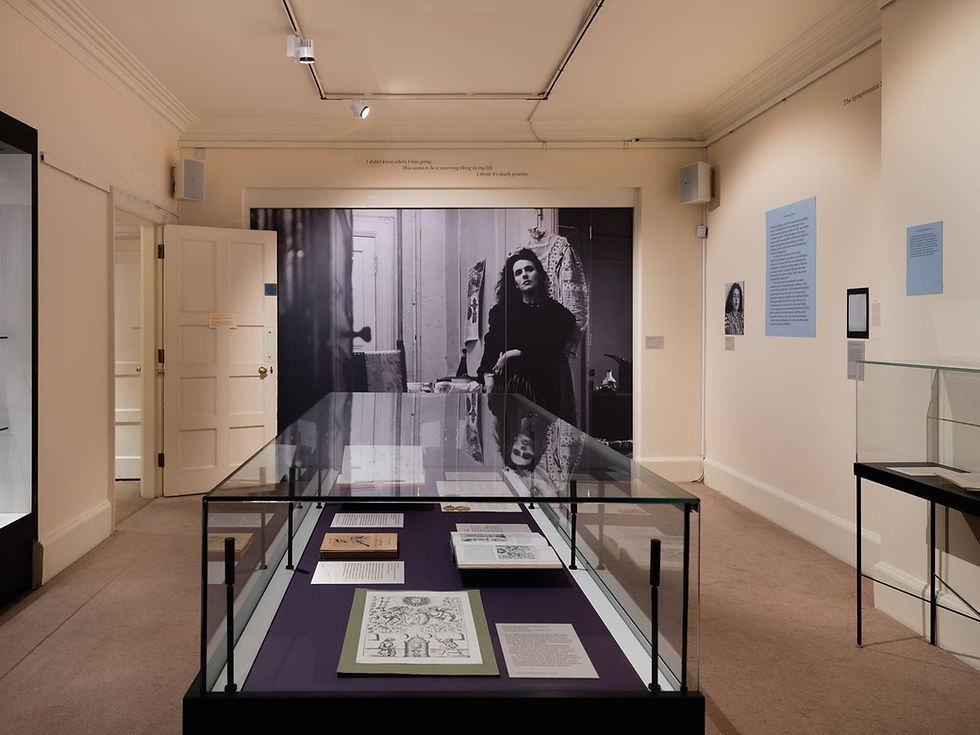
Courtesy of the Freud Museum London. Artworks © 2026 Estate of Leonora Carrington / ARS, NY and DACS, London. Ph. © Lewis Ronald
In 1938, the English author and artist Leonora Carrington (1917–2011) was living an idyllic life with her lover, the Surrealist painter Max Ernst (1891–1976) in Saint-Martin d’Ardèche in the south of France. Leonora wrote stories and painted while Max sculpted fantastic creatures that adorned the exterior walls of their small stone farmhouse. Together, they entertained Roland Penrose, Lee Miller, Leonor Fini, Paul Eluard and other friends from their avant-garde circle. This idyll abruptly ended when, in 1939, France declared war on Germany. The German-born Ernst was interned as an enemy alien and, although released just three months later, he was soon re-arrested by the Nazis and sent to a detention camp. Left on her own, but with no desire to return to her family in England, Leonora struggled to cope with an increasingly desperate situation.
With the help of a friend, she made her way to Madrid, but her mental state continued to deteriorate. She was admitted to a sanatorium in Santander where her treatment included a course of drug therapy which induced violent epileptic seizures. Her eventual escape to New York required her to slip away from the English nanny who had been sent by her parents to retrieve her from the sanitorium, and to hastily marry Mexican diplomat Renato Leduc (a friend of Picasso’s she had met in Paris) in order to obtain the necessary exit visa for safe passage out of Lisbon.
In 1943, Leonora wrote Down Below, a graphic account of the unravelling of her mind in Santander, which was published in VVV, the Surrealist magazine. Down Below is also the title of one of two paintings she produced during her time in the sanitorium. A new exhibition at London’s Freud Museum, The Symptomatic Surreal, brings together the painting, exhibited in London for the first time, with drawings from sketchbooks that Leonora kept from 1939 to 1941. These are presented in dialogue with objects from Freud’s extensive collection of Greek, Roman and Egyptian antiquities – archaeological finds that embody past civilisations which, as curator Vanessa Boni explains, “Freud used as tools to help him think about the structure of the mind and the unconscious.”

Courtesy of the Freud Museum London. Artworks © 2026 Estate of Leonora Carrington / ARS, NY and DACS, London. Ph. © Lewis Ronald
The Surrealists, of whom Max Ernst was an early exponent, drew on Freudian theory in creating works that combined dream and reality and sought to tap into the unconscious as a way to free themselves from the constraints of traditional art theory and practice.
On a rainy Friday afternoon, as the trees in the garden of Freud’s last home in London were coming into bloom, and where his study, with its ancient treasures, remains virtually unchanged since his death, Boni provided further context to the exhibition.
Restoration Conversations: How did the idea for the exhibition come about?
Vanessa Boni: I began seriously researching Leonora in 2022, a couple of years before I started working at the Freud Museum. Initially, I was looking at Carrington’s goddess imagery and asking how her experience of the psychiatric system, as a woman in the 1940s, may have shaped her feminist consciousness. When I later joined the museum, I remember standing in Freud’s study and being struck by the proximity of goddess statuettes on Freud’s desk and an image of a hysteria patient from the Salpêtrière above his couch. The exhibition evolved from that moment.
RC: Why did you choose to focus on Leonora’s sketchbooks?
VB: In October 2024, I went to see the exhibition Avatars and Alliances at Firstsite in Colchester, which included one of Leonora’s drawings from her Santander sketchbooks. When I started looking into it, I discovered how little had been published on the sketchbooks and I thought they might be a way to revisit the period Leonora described as “down below”.
RC: How did you go about tracking them down?
VB: The sketchbooks were part of a large collection of Surrealist works owned by the gallerist and collector Julien Levy in New York. Leonora gave them to Levy when she arrived in New York in 1941, having been introduced to him by the Surrealists in exile who gathered there. When Levy died in 1981, his wife Jean set up a foundation to oversee the collection and, after her death in 2003, the collection was auctioned off.
RC: Was there never a thought of returning the sketchbooks to Leonora?
VB: There is nothing in the archive about what she was thinking when she gave them to Julien. I don’t know if she attached any conditions to them. I do know that she was very upset at the thought of them being sold. They were intensely personal to her as they were part of the most difficult time in her life. And perhaps she didn’t see them as artworks or expect them to be publicly viewed.
RC: Did the prospect of publishing this material feel transgressive given its sensitive nature?
VB: As a curator working on this material, I’ve been aware of those transgressions from the perspective of the artist, and I have been sensitive to this. But their ontology has changed, because as soon as they were sold in that auction, they became part of the art market.
RC: What sort of condition were they in?
VB: Many of the pages were crushed or torn and folded. They have the traces of her journey from when she left Saint-Martin d’Ardèche, then on to Madrid, to Santander, to Lisbon and, finally, to New York.
RC: Am I right in thinking that the sketchbooks are never mentioned in Down Below, Leonora’s written account of her time in Santander?
VB: That’s true. She never directly refers to them. She does mention that one of the doctors gave her a pencil and some paper and that Dr Morales had encouraged her to draw as a way of communicating to him how she was feeling. Those drawings were separate from the sketchbooks and are all lost.
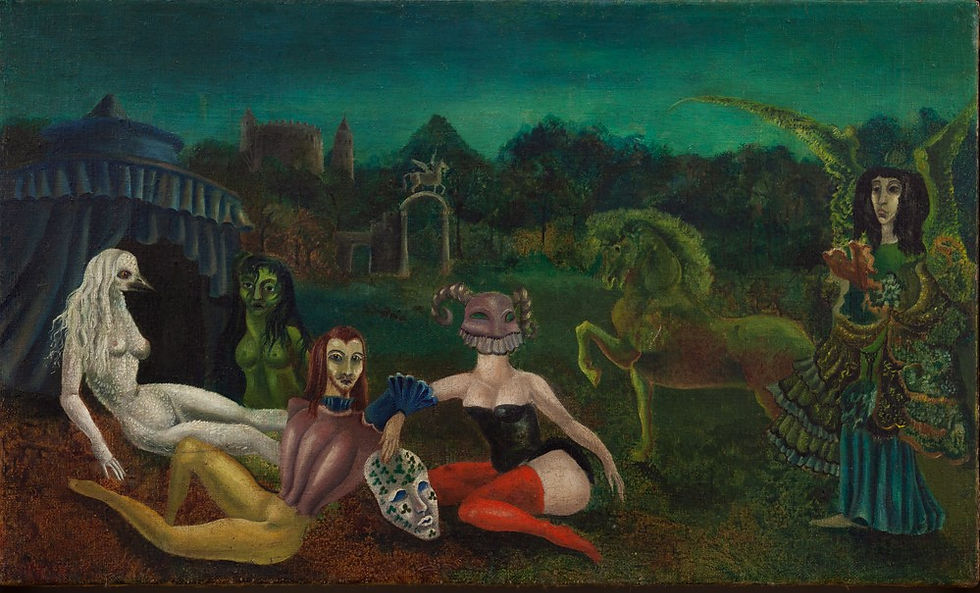
Leonora Carrington, Down Below, 1940. Private Collection, Mia Kim. Image Courtesy of Gallery Wendi Norris, San Francisco
© 2026 Estate of Leonora Carrington / ARS, NY and DACS, London
RC: What is the significance of the exhibition title, The Symptomatic Surreal?
VB: Freud talked of ‘symptoms’ as signs or symbols, a way of communicating a conflict that is going on in the unconscious. So, the exhibition is questioning how Carrington’s images operate symptomatically by communicating something in an indirect way.
RC: Leonora didn’t formally identify herself as a Surrealist artist. Was she influenced by Freud’s theories?
VB: She wasn’t actually very interested in Freud, which I think makes her work even more compelling at the Freud Museum. Her art resonates with psychoanalytic ideas without simply illustrating them. It is important to remember that Freud’s theory of the unconscious was a major influence on Surrealism and, while women’s contributions to Surrealism were often marginalised, Leonora and other women artists participated in the Surrealist exhibitions in London and Paris in 1936 and 1938, and then in New York in 1942. She was working with Surrealist ideas, but she transformed those ideas. There was a kind of feminist reimagining of them.
RC: From the opposite perspective, did you come across any evidence that Freud was aware of Carrington or her work?
VB: No. He wasn’t particularly interested in Surrealism. He was interested in ancient artifacts and the Renaissance. He wrote about Leonardo da Vinci and Michelangelo. Salvador Dalì visited Freud in 1938 and drew a portrait of him that is on display on the landing. On seeing Dalì’s Metamorphosis of Narcissus, Freud commented that, in classical paintings, he looked for the unconscious, but in Dalì’s work, he looked for the conscious, which Dalì took to be criticism.
RC: The various hybrid human-animals inhabiting the grounds of the sanitorium in Santander in Leonora’s painting Down Below, have been interpreted as representing different aspects of the artist. Is that just one way of looking at the work?
VB: This may have been her way of describing what she was going through. These ideas of hybridity and multiplicity and metamorphosis are interesting aspects of the painting. There is masking as well, because the figure in the middle has a mask as a head and another in the hand. So, there is the idea of becoming ‘other’ or being in between different selves.
RC: Leonora’s account in Down Below makes for difficult reading. What was your experience on studying it so closely?
VB: It’s an incredibly intense read. Leonora shares her experience so vividly and viscerally. Every time I return to it, I’ve needed hours to feel okay again. To cope with her emotional distress, she imagines alternative realities and gives form to her crisis through the invocation of a symbolic underworld. Her descent has been compared to other literary journeys into hell, like those of Dostoevsky or [American author Joseph] Campbell. Freud was also interested in the underworld – as a metaphor for the unconscious – and collected statuettes of underworld deities. Bringing Carrington’s work and Freud’s objects together in this exhibition draws out unexpected affinities we might not otherwise have imagined.


Comments