.jpg)

It Runs in the Family: The Legacy of the Nicholson Women
- May 22
- 5 min read
Relative Ties, the current exhibition at the Women’s Art Collection (WAC) at Murray Edwards College in Cambridge, explores the work of four women of the Nicholson family.
By Margie MacKinnon
Originally published in
SPRING/SUMMER, Issue 9

EQ Nicholson, Runner Bean, c. 1950, wallpaper, © Estate of EQ Nicholson, private collection
Relative Ties, the current exhibition at the Women’s Art Collection (WAC) at Murray Edwards College in Cambridge, explores the work of four women of the Nicholson family. Successive generations of Nicholsons have produced numerous artists, among whom the best known are William and his son Ben but, in this show, the men are not the principal players. Here, the focus is on the artistic output of the Nicholson women, as well as on the relationships between them, and the ways in which they influenced and supported each other. As curator and Director of the WAC Harriet Loffler explains, “the exhibition explores what women inherit from their mothers, what can be passed down matrilineal lines, and the importance of siblings to a creative practice.” The exhibition also includes new works created by Katie Schwab (see Restoration Converstions Issue 9).
It starts with Mabel Pryde Nicholson (1871-1918). The two portraits of her children on display exemplify the focus of her work and the restrictions on her output. Descended from generations of painters and engravers, Mabel had four children with her husband William, whom she met at art school. A devoted mother, she temporarily stopped painting while her children were young and ultimately managed to complete no more than 50 works. Her use of her children as models, dressed in theatrical costumes or posed in domestic settings, encapsulates her success at fusing her art practice with motherhood. Her fondness for dark backgrounds was thought to be influenced by Manet, and, while she would have been aware of the new trends emerging in the late Victorian art world, she did not subscribe to any one in particular. One of her most notable achievements was to encourage her daughter Nancy’s creative leanings.
Unusually, Mabel paid her children when they sat for her works. For Nancy Nicholson (1899-1977), this was an early lesson in independence and equality. At just eight years old, she identified as a suffragist, during the First World War she joined the Land Army and, on marriage to the writer Robert Graves, kept her own name – contrary to the prevailing practice. Nancy began her artistic career as an illustrator and later began experimenting with textile printing. After separating from her husband, she set up Poulk Press where she produced her own stationery and printed designs for her brother Ben and his second wife, Barbara Hepworth.

Elsie Queen (Myers) Nicholson (1908-1992), who preferred to be called ‘EQ’, was the daughter of privilege, growing up in a home surrounded by servants and regularly visited by writers and artists. Her paternal grandmother was Eveleen Myers, a self-taught photographer credited with more than 200 photographic portraits in the National Portrait Gallery. EQ’s formal art training was somewhat sporadic, but a stint as an assistant to textile designer Marion Dorn provided sufficient experience and self-confidence for EQ to begin creating her own designs. After her 1931 marriage to Kit Nicholson, Nancy’s younger brother, EQ worked on interiors commissioned through Kit’s architectural practice and, from 1936 began working with Nancy.
Despite the nine years between them, Nancy and EQ became very close, as evidenced by their correspondence over 20 years, now in the archives of Tate Britain. They shared an artistic sensibility that was linked to the domestic sphere and their common delight in gardens and the natural world. Both women became single mothers, and their work reflected their familial preoccupations. Over the years, they produced designs for textiles, prints, stencils and wallpapers, taking satisfaction from creating objects that were both practical and beautiful. While Nancy refused to allow her designs to be machine-produced in order to preserve their handmade quality (some of the lino blocks she used are displayed along with her patterns), EQ did not eschew commercial production. Black Goose, was screen-printed by Edinburgh Weavers, and Runner Bean, one of her best-known designs, was used for hand-printed wallpapers by Cole & Son.
Nancy Nicholson’s great-great niece, also called Nancy, is a textile artist working in Devon who creates woven designs for wall hangings and rugs. Growing up, she was surrounded by objects created by various family members, and she knew of the older Nancy’s formidable reputation as an artist and non-conformist.
On viewing the exhibition, she observed, “It is wonderful to see so much work from these four women on show, but I was struck most by the descriptions of the creative force in Nancy and EQ’s friendship. I knew they were both impressive individually, but the cumulative force of a creative female friendship is a powerful thing and Relative Ties does a brilliant job of making the story of this one so tangible and alive.”

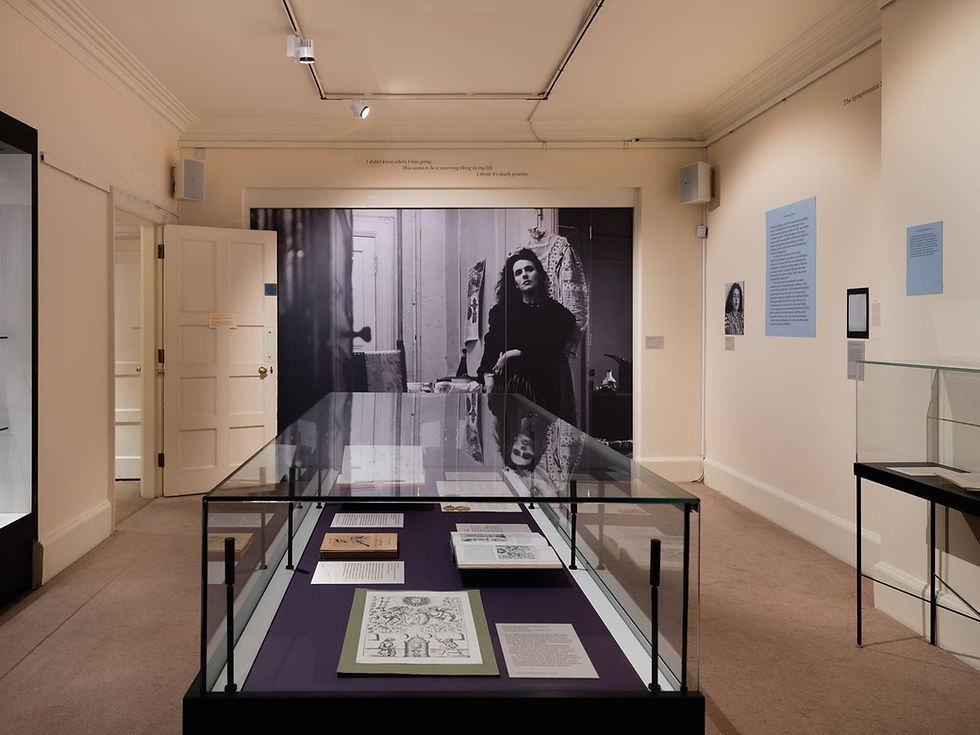
Installation view, ‘Relative Ties’ curated by Harriet Loffler, featuring works by Louisa Creed, ph. Jo Underhill
EQ’s daughter, Louisa Creed (b. 1937), did not immediately follow in the footsteps of her artistic forebears. Instead, she pursued a career in music, becoming an accomplished flautist. However, her chance discovery of the craft of rag-rug-making led to a second career which began in 1989. Largely self-taught, she has created over 200 rag rugs, helping to revive a skill that was in danger of dying out. The influence of her family’s artistic background is evident in her style, her choice of subjects and her economic but effective use of colour.
Louisa’s rugs – which are meant to hang on the wall – are handmade and have a painterly quality. Two were directly inspired by paintings of her aunt Winifred Nicholson. Her own designs are simple and reflect an interest in the natural environment, not unlike the designs of Nancy and EQ. Louisa’s gift to the WAC of one of her rugs, Hunting Cat, together with EQ’s painting, Jugs and Quinces (1946), was the seed that has grown and ultimately flowered into this exhibition.
Winifred Nicholson’s daughter, Rafaele Appleby, explains the effect of the family legacy on her art practice in Cumbria, where she creates vibrant works inspired by nature: “Over the years, as I discover more about the women artists in my family, I am struck by one thing: that for them art is collaboration, sometimes by working on the same project together, at other times creating images that spark new ideas across the studios, across the years, across the generations.
“Mabel wove motherhood into her work with such deft brushstrokes that you feel her love for the children she painted. Nancy was feisty and quite able to stand up for herself without losing any subtlety in her work. EQ’s work is less familiar to me, and I loved meeting more of it in the exhibition. I am so happy to count her daughter Louisa, who taught me how to make rag rugs, among my friends. As I work in my studio I feel their steady encouragement around me. It is time for these wonderful creative women to step out of the shadows and into the light.” MARGIE MACKINNON
The catalogue that accompanies the Relative Ties exhibition was supported by the Calliope Arts Foundation.


Comments