.jpg)

Forces to be reckoned with
Renaissance Women: From d’Este to Dunant
By Eleanor Walker
Originally published in
RESTORATION CONVERSATIONS magazine
Renowned British author Sarah Dunant is known for her writing featuring strong, independent women in important Renaissance centres.

From In the Company of the Courtesan, and Sacred Hearts, to In the Name of the Family and The Birth of Venus, her novels are laced with thorough research and knowledge of the period. They make for a wonderful journey into the worlds of figures who, more often than not, are left out of history books. Her latest novel, The Marchesa, explores the fascinating life of Isabella d’Este, art collector extraordinaire, ruler and accomplished manipulator. This is no romp through 15th century and early 16th century Mantua; instead, we are party to the very real highs and lows of life as a noblewoman, the luxuries as well as the limitations that come with governing a small, but powerful city-state in a time of great turmoil.
Of all the Renaissance women whose stories have survived to the present day, Isabella’s is perhaps one of the most well-documented. It is unusual for us to know so much about women of this period, as their lives are normally handed down to us through the annals of history, and recorded solely in terms of whom they married, how many children they had, and when they died. Rarely are we afforded a glimpse into their passions, jealousies, their grief, and the challenges they faced – but we know their lives were extremely complex, even precarious. In the case of Isabella d’Este, however, there is a surplus of ‘data’ recounting her legacy. Staggeringly, she penned some 33,000 letters. They contain rare and fascinating glimpses into her life and served as the main source for Dunant’s book.
We are introduced to Isabella in the first person, speaking directly to us from Dunant’s pages. From the very start, we become a silent confidant to this forthright young woman, who acknowledges, in no small part, her skills with scents, “I have always had the most sensitive nose … Even as a child I registered the way perfumes and bodies fused together. As an adult, I could identify each of my ladies with my eyes closed and smell my husband when he was two rooms away.”
In this first ‘conversation’ with Isabella, she proclaims, “I was an expert in perfumes and designed and gifted scents for women of good families all over Italy and beyond”. We are immediately transported into the realms of ‘informed imagination’, where historical fiction – when written as intelligently as Dunant’s – teases the senses and evokes forgotten experience. “History is only the words,” Dunant remarks, when considering how much is lost to us, when all we have to show for a woman’s life are account books and letters – pen and ink on paper. Yet, through Dunant’s first introduction to Isabella’s character, we can imagine the rose water, the lavender – the ointments and lotions Isabella or her ladies in waiting would have made from steaming and steeping various herbs and flowers. Scent, a sense so strongly connected to memory, seems a fitting start to this journey into fifteenth-century Mantua otherwise inaccessible to the 21st-century Renaissance enthusiast.
References to the senses are threaded throughout The Marchesa, where the sights, sounds and textures of the past come alive on the page. From the cravings for sweet marzipan fruits from Naples (a favourite of the Marchesa’s) to the sight of the horrors of the sack of Rome in 1527, Dunant brilliantly recreates the delights, terrors and struggles of Isabella’s world.
When speaking on the book in November 2025 at The British Institute of Florence, Dunant said of Isabella that “her voice was too strong”. It’s as if she, the author, had no choice but to let this woman speak through her pages; “her personality is in the letters.” Isabella’s strength of character and the clarity of her voice is what inspired Dunant to write her narrative with Isabella’s ghost looking over the shoulder of ‘The Scholar’, a woman visiting the archives in Mantua to research the letters. Throughout the book we jump between these archives and the life of Isabella, as she defends her actions and describes the vicissitudes of her eventful life.
Intelligent, conscientious, cunning, determined and incredibly manipulative, the Marchessa was certainly a force to be reckoned with. By Dunant’s own admission, Isabella is a cross between Margaret Thatcher, Angela Merkel and Anna Wintour. This is not to say that she has been cast in a negative light as some sort of villain, or ‘difficult woman’. Instead, we are transported into her world and led to see it as she did, and to see her, according to the mores of her own time. Whilst depicting Isabella’s story, Dunant drew on a familiar quote by LP Hartley in The Go Between, “the past is a foreign country; they do things differently there.”
“My job” Dunant explains, “is to help you, the reader, understand that soil.”
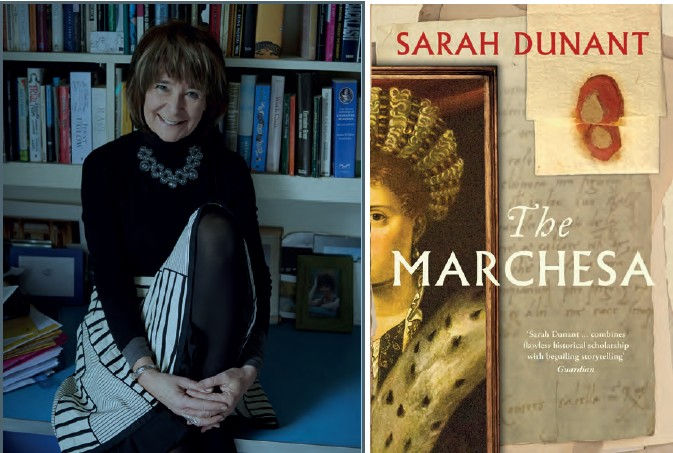
Author Sarah Dunant (ph. Charlie Hoptinson) and her book The Marchesa
We are guided to contemplate Isabella’s character as a whole – the jealousy she felt towards her beautiful younger sister for marrying into the more prestigious and wealthier Sforza family, her love for her eldest son in his infancy, and her later management of him as regent. We are with Isabella when her second child, another daughter, sadly dies after only 8 weeks. Isabella describes a deep “chill” surrounding this birth, which ultimately drove her to leave the city, only to return once the child had died. Whilst her relative coolness might be heartbreaking today, we are reminded of how Isabella’s world was a very different place than ours. Boys were essential for a happy, or rather ‘secure’, dynastic marriage, and one was not enough. The more the safer, if not the merrier.
As far as happiness was concerned, art was essential to Isabella. Together with fashion – for which she was the trendsetter of her day – art was one of her main sources of joy. She clearly found collecting a thrill, and her collection alludes to her knowledge of the masters, both of the classical world and of her own. She was keen to show it off as well; modesty does not seem to have been in her vernacular.
A patroness with a passion for beauty and an eye for quality, she left her mark as a shrewd and determined collector. Isabella’s magnificent collection was comprised of paintings, sculptures, books, coins, instruments and curiosities. An inventory of the collection, compiled in 1542 by the Gonzaga court notary Odoardo Stivini, three years after her death, listed over 1,600 items. Sadly, the collection has long since been sold, lost or dispersed.
Isabella’s letters reveal the lengths to which she would go to procure artworks. From reports from her agent in Greece on the finding of a classical bust of Homer (albeit missing his nose) to her incredible gall in writing to the Pope to inquire whether she could ‘rescue’ certain items from Urbino when the court was mercilessly taken over by his tyrant-son Cesare Borgia. If not directly referenced in the novel, these events are laced seamlessly into the story to illustrate how driven Isabella was as a patron of the arts. Then, of course, there are the artworks she commissioned. So precise and exacting was Isabella that it is no wonder her court artist Mantegna, whilst known to be contentious in character, was particularly so, when it came to accepting work from his Marchesa.

The Marchesa was the first to house her treasures within her very own studiolo, or rather studiola to use the feminine, and grotto(a). Today, these spaces are comparable to a ‘study’, where the most precious personal items in the palace were kept and flaunted to any renowned guests, to boost the host’s ego. Whilst not uncommon to the upper echelons of Renaissance society, a studiolo was usually reserved for the collections of its lord, rather than its lady. Isabella, however, commandeered and decorated two small rooms in the palace in Mantua, where she kept her most treasured possessions. It was where she wrote, and stored her most private correspondence.
Whilst today there is not much left, except the shell of the physical space itself, the room has been brilliantly recreated by researchers at IDEA (Isabella d’Este Archive) and faithfully reconstructed digitally. Dunant’s words and these visuals, afford us the opportunity to be immersed in the world of this intrepid art expert.
Because of Isabella’s strong connection to the visual arts, Dunant, quite rightly, was adamant that her novel include images. When met with resistance from publishers on account of the cost of printing a novel with colour illustrations, some of Isabella’s fire appears to have rubbed off on the author. She took the bold step to self-publish, determined in her aim to do justice to Isabella’s tastes and artistic ventures. Whilst this edition may be slightly harder to find in bookshops, it can easily be ordered online. Apparently, nothing will stop Isabella, or Dunant, from achieving something when they put their minds to it, and for that, we, as their audience and admirers, should give thanks. May their fire fuel us to follow their example in our own endeavours. ELEANOR KATE WALKER


Comments