.jpg)

‘Artist and Friend of the Poor’
Personal Reflections on Sarah Cecilia Harrison
By Anne Chisholm
In the tall house in Hampstead where I grew up hung a number of large, dark portraits in gold frames. The only one that caught my eye was that of a beautiful dark-haired woman, her lips parted, wearing a slightly decollete black dress. My mother told me that it was a portrait of my Irish grandmother, Eliza Beatrice Harrison, painted for her engagement to my English grandfather, Hugh Chisholm, by her younger sister, my great-aunt Sarah Cecilia Harrison. This information was of minor interest to me at the time.
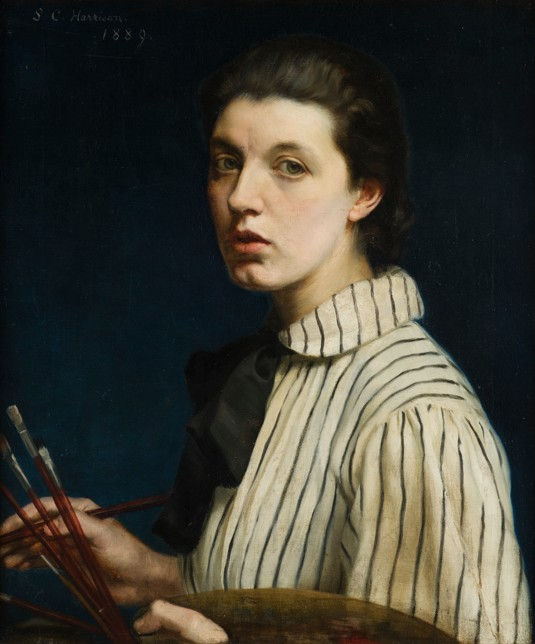
Sarah Cecilia Harrison, Self-Portrait, oil on canvas, 1889, collection and image © Hugh Lane Gallery Dublin
Sixty years later, I decided to find out more about this great aunt who, I had since realised was a woman of considerable if under-recognised achievement, not just as an artist but as a social reformer. I went to Dublin in pursuit of her and found her grave in the Protestant cemetery. On the tall grey cross was inscribed ‘Artist and Friend of the Poor’, an inscription which indicated a relative to admire. From my father, a man of naturally conservative attitudes, I had grown up with the impression that, within the family, Aunt Celia (as she was known) was thought to be a bit odd: she was unmarried and had chosen to live alone in Dublin on very little money, working as an artist and campaigning against social injustice. He did express some pride that she had been the first woman to be elected to Dublin City Council, in 1912. This achievement interested me less than his assertion that she had once been engaged to someone important in the art world who had drow
ned when the Lusitania was sunk by the Germans off the coast of Cork, during the First World War. According to my father, this man had owned several valuable paintings which should have passed to Aunt Celia. On a visit to the National Gallery in London I was told that a painting I admired, Renoir’s Les Parapluies (1881), was one of them. This made a lasting impression. For a long time, this was all I knew about my Great Aunt Celia, and I suspected it was not entirely accurate. My father, after all, loved a good story.
I went in search of the facts. Celia was born in 1863, at Holywood House, County Down, just outside Belfast, third of the five children of Henry Harrison, a prosperous merchant of Scottish descent and his wife, Letitia, nee Tennent, from one of Belfast’s leading political families with a proud Liberal and Nationalist history. Although the Harrisons, like most of the Protestant Anglo-Irish, were staunch Unionists, believing Ireland should be ruled from London, Celia was always strongly in favour of Home Rule.
When Henry died in 1873, Letitia and the children moved to London; three years later, when Celia was 15, she began six years of study at the Slade, the recently founded art school where, for the first time, women studied and painted alongside men. She thrived there, winning a scholarship and several prizes for drawing and etching. Under her mentor, Alphonse Legros, she developed into a fine, perceptive painter in the traditional style, heavily influenced by the Old Masters. She soon began her career as a portraitist, using her family and friends as models; she also painted a series of striking self-portraits (Self Portrait, 1889). Her work was shown frequently from 1889 onwards at the Royal Academy in London (Miss Beatrix Harrison, 1888), the Royal Hibernian Academy in Dublin and the Belfast Art Society. By 1900, she was a highly regarded artist, producing a steady stream of portraits of prominent people in London and Dublin. (Portrait of George Moore, 1907).

Sarah Cecilia Harrison, E. Beatrix Harrison, oil on canvas, 1888, private collection
Although by no means drawn to Impressionism, let alone Modernism, Celia appreciated these movements; and after she met the leading art dealer and collector Hugh Lane, a well-connected Anglo Irishman, she committed herself to helping him in his efforts to establish a gallery of modern art in Dublin.
She had moved back to Dublin by 1904 and was to live and work there for the rest of her life. The move was for personal as well as professional reasons. She was the only one of the Harrison sisters not to have married, while in 1896 her mother, then in her fifties, had remarried a man of 27, giving Celia a stepfather four years younger than she was. She must have felt it was time to set up life independently, although she continued to visit the family in London.
In Dublin Aunt Celia found herself so appalled by the poverty and squalor of the city’s infamous slums that she embarked on the series of campaigns – for better housing, help for the unemployed and the establishment of allotments, in particular – that led to her standing for office on the Dublin Council in 1912. She also became a leading suffragist, marching and addressing public meetings in London and Dublin.
At the same time, she began to work increasingly closely with Hugh Lane towards realising his grand ambition of an Irish Gallery of Modern Art based on works from his own collection, which included Corots, a Manet and Renoir’s Les Parapluies. They became friends as well as colleagues, and when the Municipal Gallery of Modern Art opened in temporary premises in 1908, she wrote the catalogue for the first exhibition, which included three of her own works, including a self-portrait.
As a member of the Council, she was in a perfect position to lobby for Lane’s proposal. Aunt Celia fought hard on her friend’s behalf, supporting, among others, a scheme for the construction of a Lutyens building on a bridge over the Liffey. But those who felt the Council had more urgent demands on funds won the day, aided by the outbreak of war in 1914. In January 1915, she lost her seat on the Council. Meanwhile Lane, losing patience, had also been negotiating with the National Gallery in London.
In May 1915, on his way back from a business trip to the United States, Hugh Lane, along with some 1,200 others, was drowned when the Lusitania was torpedoed by the Germans off the Irish coast. In the wake of this disaster, and the discovery that Lane had left conflicting wills – so that both London and Dublin had a claim on his collection – Aunt Celia came forward with a claim of her own. She maintained that she and Hugh Lane had agreed to marry, and that, though she knew he intended the paintings to go to Dublin, both wills should be declared invalid. This was partly because she herself was left only a token gift. The story of the legal tangle that ensued, the eventual settlement in favour of London, with the proviso that certain paintings would be shared with what eventually, in 1928, became the Hugh Lane Gallery of Modern Art, is long and complex. But for Aunt Celia, it was a disaster. The engagement was strongly denied by Lane’s family and friends and universally disbelieved; he was, after all, younger, being barely 40 to her 52, and had never seemed the marrying kind. Aunt Celia was perceived, from then on, as deluded, obsessive and, as she repeated her story over the years, something of a nuisance.

Sarah Cecilia Harrison, Michael Collins, oil on canvas, 1924-5, courtesy of OPW State Art Collection
Here, I realised, was the sad, true story behind my father’s claim that Les Parapluies should have been hers. It seems clear to me now that, whatever their relationship had been, Lane’s death pushed Aunt Celia into an emotional crisis, even a breakdown, from which she was slow to recover. By the 1920s, though, she was painting again, and as I discovered in Dublin, her later portraits of distinguished citizens can still be found in public buildings, including the Prime Minister’s office (Portrait of Michael Collins, 1924). Her posthumous portrait of Lane hangs in the Hugh Lane Gallery. To the end of her life, she continued to support the poor and the unemployed.
Through a great stroke of luck, I have been able to help restore the memory of Sarah Cecilia Harrison to what I believe she was: a strong woman, a truly gifted artist and a force for good. Eight years ago, I was contacted by a Dublin bank, who wished to hand over to me some four hundred letters, dated 1905-15, from Sir Hugh Lane to Miss S.C. Harrison. They showed no evidence of a romance, but were proof of a productive, affectionate friendship and a working relationship of great interest to Irish art historians. These letters, purchased by the National Gallery of Ireland, are now held in their archives and are available to scholars. The proceeds from their sale are used to fund the Sarah Cecilia Harrison Essay Prize, awarded annually for a piece of research into any aspect of women’s art in Ireland.
I hope my Great Aunt Celia would approve.


Comments