.jpg)

Marie-Clémentine, Maria and Susanna
Becoming Suzanne Valadon
By Margie MacKinnon
Originally published in
RESTORATION CONVERSATIONS magazine

Suzanne Valadon, 1923, The Violin Case, Musée d’Art Moderne de la Ville de Paris. Source: Wikipedia
Suzanne Valadon’s life reads like a paperback novel, with a plot that takes the heroine from obscurity to notoriety and, belatedly, much deserved acclaim. Its setting is Montmartre, the bohemian centre of turn-of-the-century Paris, and the cast of characters is a roll call of famous Impressionist and early modern artists. There is no need to embellish the facts because the improbable details are all true. She was an artist’s model for some of Auguste Renoir’s best-known works; her mentor was none other than Edgar Degas; her lovers included Henri de Toulouse-Lautrec and Erik Satie; her son, Maurice Utrillo, was also a painter, whose early success would eclipse her own. Along with Picasso and Modigliani, she was one of the young artists championed by Berthe Weill and exhibited at her eponymous gallery in the early years of the twentieth century.
Marie-Clémentine Valadon, as she was first known, was born out of wedlock and into poverty in 1865 in Bessines, a farming community in the Limousin region of France. Seeking to improve her prospects, Valadon’s mother, Madeleine, moved the family to Paris in 1870, a time of turbulence with the end of Napoleon III’s reign and the short-lived Commune of Paris. Montmartre was at the heart of the action and the artists who had gravitated there began increasingly to distance themselves from the bourgeois art establishment. By 1874, their displeasure with the official Salon led a group of them, including Cezanne, Degas, Renoir, Monet and Morisot to plan their own exhibition, which opened two weeks before that year’s Salon. This spirit of rebellion pervaded the environment in which Valadon grew up. And, although she was too young to have visited the exhibition, she was already taking every opportunity she could to express herself in pictures, drawing on walls or bits of scrap paper in chalk or charcoal. Too restless to stay in school, she had the run of the neighbourhood which, at that time, still had the feel of a country village, and she spent hours observing the comings and goings of its denizens. It was said that at the age of eight she stopped to watch Renoir at his easel working en plein air and encouraged him to keep on with his painting as she was sure he had a bright future.
At the age of 11, Marie-Clémentine left the convent school that Madeleine had enrolled her in, becoming an apprentice seamstress in a local milliner’s workshop. Unable, or certainly unwilling, to stick to regular employment, she left to work in a variety of casual jobs including, briefly, a stint in the circus as an acrobat, which was cut short by a bad accident. She continued to draw and even started to paint, making her own colours. Her proper introduction to the art world came through a young Italian friend who took her around the studios where she was working as an artists’ model. Valadon caught the eye of a well-known landscape painter, Pierre Puvis de Chavannes, for whom she would model off and on for seven years from the age of fifteen. During her long hours of sitting for him in his airy studio in Neuilly, on the northern edge of the city, Valadon absorbed every detail of his working methods – from mixing paints and arranging a composition to preparing for exhibitions and haggling with dealers. She also re-invented herself as ‘Maria’, a more exotic name chosen to help her fit in with the young girls from the outskirts of Naples who had settled in Paris and excelled at finding work as models.
With Puvis’ name on her resume, Maria was able to establish a career modelling for other artists, many of whom are now completely forgotten. But one stands out. In 1883, she began to model for Auguste Renoir who was then moving away from Impressionism and back to a more formal style. Renoir immortalised Valadon in his Les Parapluies (see p. X) and in Dance at Bougival (1883) which captures his sitter’s beauty as well as her youthful joie de vivre.
Renoir would eventually discover that his model had artistic aspirations of her own. Calling on her at home when she had failed to show up for a sitting, he discovered her engrossed in her drawing. While he acknowledged the quality of her work, he offered no further critique or guidance.
As a respite from the arduous task of holding long poses in drafty (in winter) or sweltering (in summer) ateliers, Maria spent her leisure time in the cafes and cabarets of Montmartre where painters, writers and art critics gathered. In this raucous and slightly seedy milieu, she met a handsome and talented young Spaniard, Miguel Utrillo, whose praise for her drawings encouraged and strengthened her resolve to continue. It is not certain (although it was widely assumed) that the two were lovers, but Utrillo left Paris in 1883 to pursue his career as an engineer. In December that year, Valadon gave birth to a son, Maurice. The father was unknown; given the carefree, bohemian lifestyle that prevailed in Montmartre, such an outcome was almost inevitable. Miguel would later ‘acknowledge’ Maurice as his son, primarily as a favour to Valadon who hoped that legitimising her child would help her to land a wealthy husband.
While Madeleine looked after her grandson, Maria continued to model, draw and paint. The family was now in a large house in the heart of Montmartre, which was home to struggling art students and artists, including Henri de Toulouse-Lautrec. The two became close friends, then lovers, with the aristocratic Lautrec introducing Valadon to literature and philosophy. By way of a mutual friend, he secured a letter of introduction to Edgar Degas, a respected painter known to champion younger artists. When Valadon nervously presented herself at his house, Degas studied her drawings and questioned her about her training, expressing surprise that a girl from her class could produce such work. By the end of the afternoon, he had bought his first Valadon, La Toilette, a drawing in red chalk of a girl getting out of the bath. Her career as an artist had begun.

Suzanne Valadon, 1922, Nude with a Striped Blanket, or Gilberte in the Nude Seated on a Bed
Paris Musées / Musée d’art moderne de Paris
Eventually, Lautrec and Valadon had a falling out over an apparent plan to trick him into marriage. It was Lautrec who suggested Valadon’s name as an artist, telling her that, as she posed for old men, she should call herself ‘Susanna’ – an allusion to the Biblical story of the chaste Susanna who repels the advances of two old men who threaten her with false claims of adultery. It is not clear if Valadon adopted the name, modified to the French ‘Suzanne’, because of, or despite, its ironic intent.
Her early drawings were clearly influenced by Degas, but Suzanne developed her own style. With no formal training, no studio and few resources for models or painting materials, she painted the people around her, without artifice, compromise or any desire to please. She drew and painted self-portraits and family members in natural, intimate poses. No stranger to the naked body, she later painted nudes, both male and female, in an unsentimental way that shocked some critics.
Some observers found her private life equally shocking. In 1893, she had a brief but intense affair with Erik Satie, during which Suzanne was said to have sexually manipulated the young, inexperienced composer. Satie was devastated when it ended after just six months and claimed afterwards never to have loved anyone else. Suzanne moved on to a new lover, the wealthy stockbroker, Paul Mousis, whom she married in 1896. But the financial stability she had longed for seemed to impede her creativity. Moreover, she had to devote more time to her son Maurice, who began to show early signs of the alcoholism that would blight his life. As therapy, Suzanne taught Maurice to paint. Like her, he drew and painted what he saw in Montmartre. Soon he was attracting more favourable attention than his mother.
Through Maurice, Valadon met an aspiring painter, André Utter, who would become a model for her nude male portraits and, eventually, her second husband. Twenty years her junior (another scandal!), Utter was friends with the younger international artists who congregated in Montmartre, painters such as Picasso, Matisse and Modigliani who were experimenting with new trends in Cubism and Fauvism. After her sabbatical of bourgeois domesticity, Valadon was re-energised and embarked on a period of productivity, painting landscapes for the first time. Her nude portraits reflected her new-found happiness, with models displaying a freedom and nonchalance, but without any attempt at flattery or ‘prettiness’. She retained her strong use of line, so admired by Degas, and resisted classification in one movement or another.
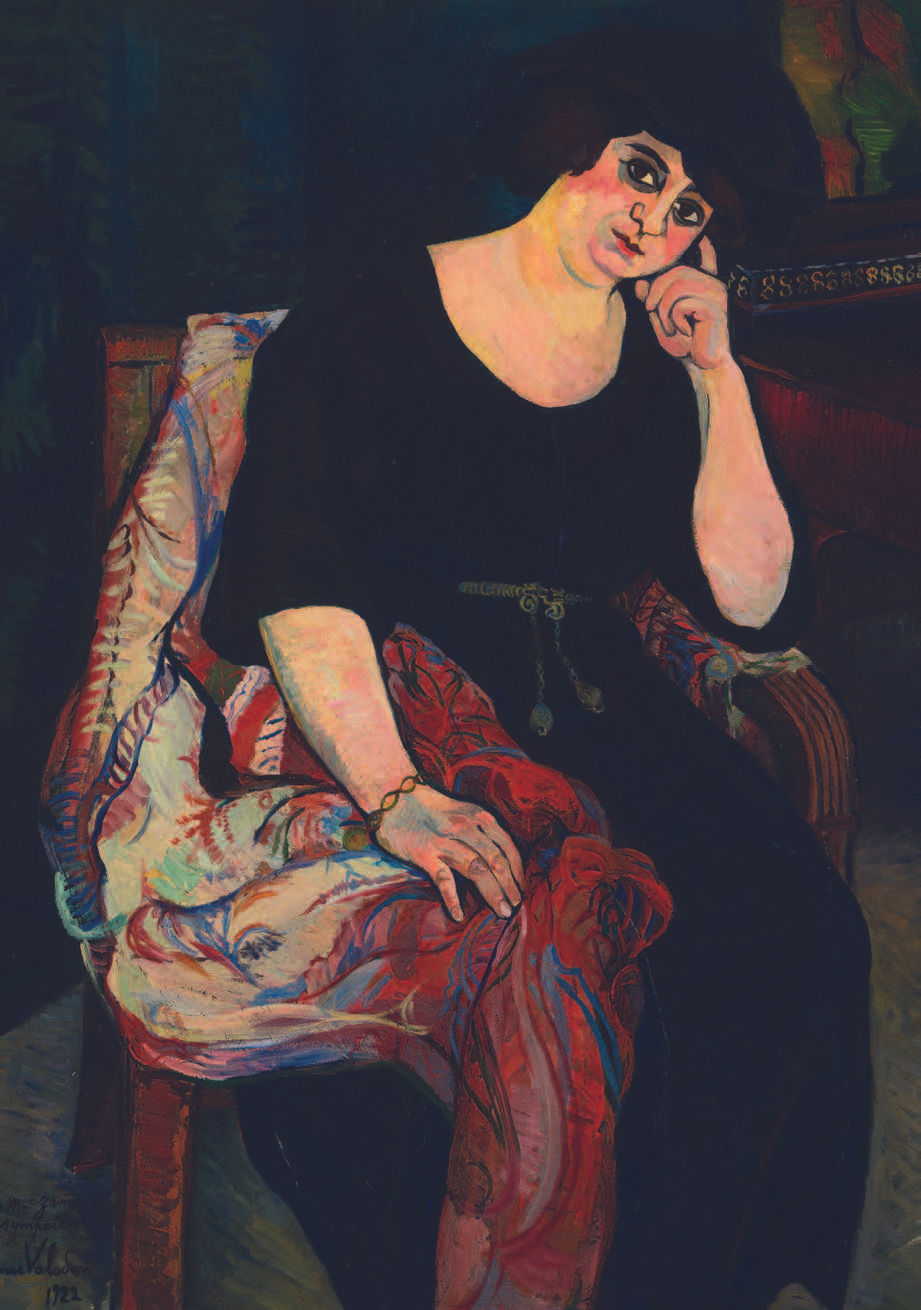
Suzanne Valadon, 1922, Portrait of Mme Zamaron. The Museum of Modern Art, New York
Gift from Mr. and Mrs. Maxime L. Hermanos © The Museum of Modern Art / Licensed by SCALA / Art Resource, NY
Valadon’s Portrait of Mme Zamaron (1922) dates from this time and shows how her personal and professional lives intersected. Maurice’s alcoholism led to frequent encounters with local law enforcement, to the extent that Valadon had become friendly with the Secretary General of the Paris Police, Monsieur Zamaron, an art aficionado who collected works by Utrillo and Modigliani. His wife is portrayed with her head resting on her hand, and a thoughtful expression on her face. Valadon dedicated the painting to Mme Zamaron ‘en toute sympathie’.
Berthe Weill exhibited Valadon’s work in her gallery from 1913 onwards, including an acclaimed retrospective exhibition in 1927. Though the works attracted interest and, from some critics, exuberant praise, for the most part, they did not sell well. Weill noted that Valadon had many detractors but, “… in spite of everything, she makes no concessions. She is a great artist.” Valadon did achieve recognition during her lifetime, especially towards the end of her career. She died at the age of 72, after suffering a stroke while painting at her easel. Today, visitors to Montmartre who wish to ride the funicular up the steep slope to the Basilica of Sacre Coeur start their journey in the Place Suzanne Valadon. Bien joue, Marie-Clémentine.
MARGIE MACKINNON


Comments