.jpg)

The Truths You Can(’t) Tell
- Jan 2
- 7 min read
Carla Danella in conversation with
author Vanessa Nicolson
By Linda Falcone
Originally published in
RESTORATION CONVERSATIONS magazine
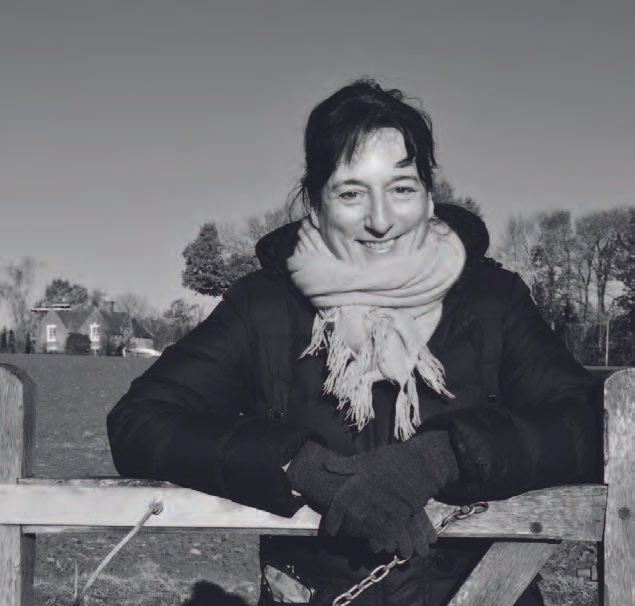
Freelance writer and curator Carla Danella speaks with long-time friend Vanessa Nicolson, an art historian and author of the memoirs Have you Been Good? and The Truth Game. More recently, Nicolson published Angels of Mud, a novel set against the backdrop of the 1966 flood in Florence, where she spent a portion of her childhood, and still lives part of the year – while not in London or at her home in the former gamekeeper’s lodge on the Sissinghurst Estate. Nicolson is the daughter of two eminent art historians, Ben Nicolson and the Florentine Luisa Vertova. She is granddaughter of aristocratic best-selling author Vita Sackville-West and diplomat Harold Nicolson, creators of Sissinghurst Castle gardens. Vanessa is a writer with the courage to begin with a paper trail of archival evidence and end in the boundless forest of
human experience. Thanks to Danella’s interview, we meet Nicolson as a teen-age daughter who grapples with her father’s homosexuality. We see her as a mother who suffers the loss of her 19-yearold daughter Rosa. As a writer and a woman, Nicolson continues to explore the after-effects of a childhood of wealth but not security, brandishing her sword – and pen – at the dragons of envy and loss.
CD: I wanted to talk to you as a memoir writer, coming from a family of successful authors and art historians. As a starting point, you use primary sources – personal letters, journals and saved paraphernalia that document generations. As much as you have found your family history to be problematic, it was one of the first to really document ‘privilege’ – female privilege, female lives and relationships. The first biography of Vita Sackville-West by Victoria Glendinning [published in 1983] was unusual for its candour. In that instance, your uncle gave its author Victoria Glendinning masses of archival material that she put in the back of her Mini and drove off with. Your family saved everything, which made it possible for their lives to be written about for the next generation. If your family hadn’t saved its correspondence, its journals, its memoirs, we wouldn’t know about them.
VN: You’re absolutely right. I work with archives and primary sources, which stems from my background in art history and academia, but research like this is problematic – with correspondence especially, not so much with personal diaries. Whatever is written on a page seems like ‘evidence’. But letters don’t necessarily reflect reality. I received a lot of very affectionate letters from my uncle Nigel – but in real life, he could be icy cold and not a warm, loving uncle at all. So, when looking at what people have recorded throughout their lives, we need to consider things with slight cynicism, or a measure of awareness. For me, I try to access something real, not imagined, and in order to remember an experience, I always go back into a ‘what did it feel like’ sort of feeling.
CD: You use the word ‘awareness’… your grandmother Vita Sackville-West, who wrote 13 novels and more than a dozen collections of poetry, is now idolised. She’s on a pedestal… when she was actually a very flawed human being. Approaches to her life-story – and to the lives of other Bloomsbury characters – tend to have become very hagiographic. People have created a cult to these personalities, when really, these were individuals with independent incomes, who weren’t always nice to people, unless they were similarly intellectual or extremely upper class. So, a lot of those who adore them now would have been the very people the group despised.
VN: Yes. My grandmother, as you know, was elitist, snobbish, quite antisemitic, homophobic – that’s the irony [despite the bisexuality of both Vita and her husband, and her well-documented affairs with Virginia Woolf and Violet Trefusis]. Of course, you do have to see everything in the context of the time. In my view, it’s not about things being black and white; it’s about understanding human beings. Yes, we’re all flawed, and we can be contradictory, and I apply that to myself as well. Even our memories can be very flawed. Memory is influenced by our convictions, and that’s something for me to be aware of as a writer.

Cover of Have You Been Good? with Vanessa as a little girl, posing for potential passport photos;
Vanessa’s first novel is set against the backdrop of the Florence flood
CD: Other people writing about the Bloomsbury group and their entourage – whether they are family or not, only write the positive. Angelica Garnett, Vanessa Bell’s daughter is an exception. She also wrote a very searing book – Deceived with Kindness – about this terribly sad, complicated situation, and then there are your memoirs – but hardly ever do we see the truth of it, in other cases. So, I think people are conditioned to think, “Oh but Vita gave trunkfuls of silk pyjamas and gold rings to her girlfriends. This is so wonderful!” They buy into that fantasy, rather than thinking, “She abandoned her two sons when they were babies, and went away for three years – and how is that not going to impact them – and their children?” That’s just one example of a trauma that’s generational, and just because it also comes with wealth doesn’t mean that it’s any less painful and damaging for the people involved. Looking back on it now, was writing your first book, Have You Been Good?, healing for you?
VN: The process was painful, but healing. As I started writing about my own childhood, I was very interested in exploring a phrase the publisher used in what we call an ‘elevator pitch’, where you summarise what the book is about for marketing reasons. ‘The darker side of privilege’ is how they described it. I first started writing in grief over my daughter Rosa’s death, but most people have suffered terrible bereavements, that wasn’t so much the issue that needed exploring. It became about having this privileged background, when all I wanted was to create something ‘ordinary’. As a child, all I ever wanted was the loving mum, the dad, the dog, the cat – it was something I craved, and created as an adult: the two children, the nice husband – a very ordinary life – and then seeing it sabotaged by the various things that happened in my daughter’s life… she had epilepsy, then anorexia, then tragically, she dies… I wrote to the fact that life sabotages one’s hopes and dreams.
CD: I know you feel ‘guilty’ for living such a privileged life and having suffered through it. It was an arid desert – which made it so important for you to create your own warm world, in your adult life, with your husband and daughters, so to see that crash is understandably devastating.
VN: There are such terrible things happening in the world, beyond terrible, and I’m wary of sounding like poor-little-rich-girl-me. But there’s this strange idea, that if you don’t have to worry about your financial security, then you are fine. Let’s say someone has had a very loving and secure childhood, and then they see me and are envious of the literary legacy… the fact that my parents knew all these incredible people, growing up in a house full of culture and books… they think of what I have as an ‘add-on’ to their secure, loving family. You crave what you are missing, and it works in every direction. As a privileged person I look at a lovely family of contadini having a spaghettata at a big table – at a fictional version of them in my mind’s eye – and I’m so envious. I don’t want them not to have it, I just crave the security that was missing in my own childhood, and couldn’t care less about the literary legacy
or the famous people. That farmer’s daughter who is desperate to make her way in the world of publishing, writing and art, might look at me and say, “Well, it was alright for her. She had the path paved ahead of her.” But we both do it. I don’t know what the answer is, apart from what I try and do, which is highlight these things in my writing, but I get very hurt when it’s misunderstood.

Luisa Vertova and Ben Nicolson on their wedding day at Palazzo Vecchio, 1955, author unknown
CD: Tell us more about The Truth Game, where does its title come from?
VN: The game was based on one I used to play with my father, a divorced dad. I would see him once a year, if that, for a few weeks. As a little child, literally ‘the truth game’ involved questions like ‘What’s your favourite colour?” and the only rule was you had to tell the truth. And as I got older, the questions got much more interesting. My father loved this… and I loved it too. When I was ten, he would ask things like, ‘If your best friend were wearing something horrible and asked you whether you thought the dress was pretty, what would you say?’ It was about honesty. He was a very honest man, my father. He had his issues and he wasn’t really a brilliant father a lot of the time, but he was a real, honest man. He would just tell you, quite hurtfully sometimes, what he thought.
But the point is, I describe us on a journey when I was sixteen, and my question to him that I remember so vividly was: “Apart from Mummy, have you ever been so in love with somebody that you wanted to marry them?” He looked very shocked and upset, and he said, “There was someone I was deeply in love with, but I couldn’t marry them.” I thought that was exciting, and began firing other questions. Was she divorced? Did you love her from afar? “Well, I answered your question,” he kept saying and wouldn’t go any further. Then I discovered a bit later that he had been madly in love with a young man, and it couldn’t go anywhere. To me, our game represented exactly what The Truth Game is about. It’s about truth and how it is interpreted. There are truths you can tell, and truths you can’t, or feel you can’t.
LINDA FALCONE


Comments